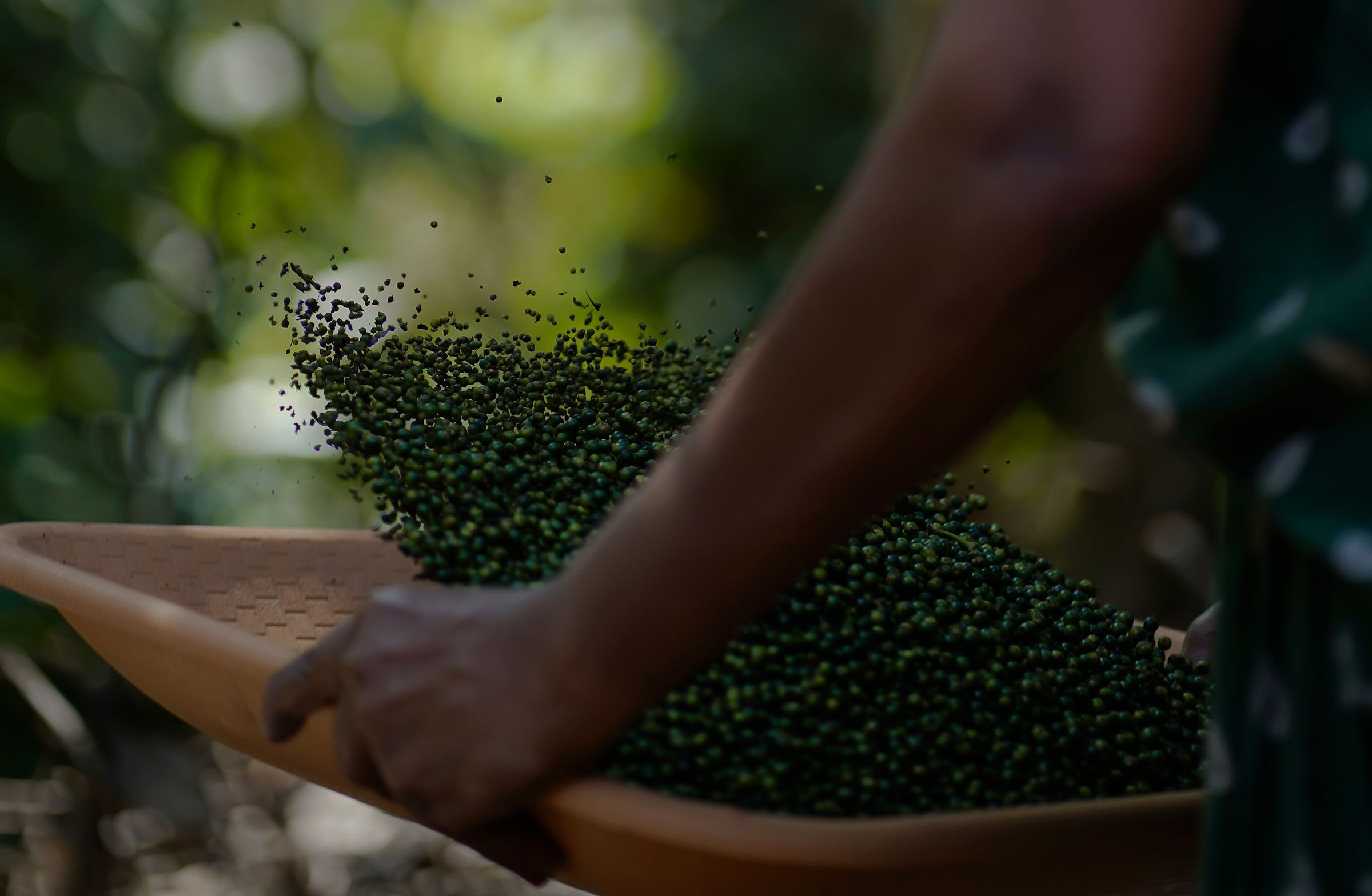
Madagascar’s wild pepper retails in France at 150 to 200 euros per kilo, a price that has made it a prized commodity among Michelin-starred chefs. Yet the premium is eating its own foundation. The spice, known locally as tsiperifery, grows on lianas that climb to the forest canopy, and demand from exporters and collectors has combined with rampant deforestation to push the plant toward scarcity.
The numbers show a resource being liquidated faster than it can regenerate. Forest cover on the island fell by 27 percent between 1990 and 2025, according to the UN’s Food and Agriculture Organization (FAO). Harvesters, unwilling to climb, often uproot the plant outright, sometimes pulling out the supporting tree as well. No reliable accounting exists of what remains.
Those closest to the trade concede the market’s role in the decline. Olivier Roellinger, the spice discoverer and longtime chef of the Maisons de Bricourt in Cancale, a three-star Michelin establishment from 2006 to 2008, told AFP: “Sometimes I think I should never have made it known.” Thirty years after first encountering the pepper, he still describes its qualities as unmatched, with a piperine content delivering notes of peat, resin and even citrus, and praises its affinity with seafood and citrus fruit salads. Commercially, the pepper found its first market in France and built a premium niche there.
Roellinger has since partnered with organizations to “obtain certifications for areas with controlled collection zones”, as happens in the Tolanaro region (formerly Fort-Dauphin, in the southeast). But he is “not fooled” by the circumvention of rules on the ground, a warning to buyers that certified supply chains face enforcement limits at origin.
The economics of depletion are already visible in villages that once lived off the trade. Ambongamarina, in the region of Antananarivo, was the setting of a pepper rush twenty years ago. Maminiaina Rabearison, a 45-year-old farmer whose village stands on a ridge bordering a protected area, recalls that until 2010-2012 the land was still covered in natural forest. “People went into the forest and for ten to twenty weeks a year, at least a hundred kilos were sold each week at the market to a collector,” he says. The collector no longer comes. Nearby forests have been consumed by bush fires, lit for charcoal, slash-and-burn agriculture, or to express anger at a distant central power. The capital lies only 120 kilometers away, yet the state of the roads stretches the journey to five hours.
Herinaina Randrianarimanga, a 51-year-old farmer in the same village, says it now takes nearly a day’s walk to find pepper. The forest edge has receded, and uprooting forces harvesters to push ever deeper for plants. In Antananarivo, green peppercorns visible in sachets sold at the Anakely market suggest uprooting continues, since green grains indicate fruit picked before maturity on destroyed vines.
For traders, the absence of data is itself a market risk. Mima Chateauneuf, cofounder of the wholesale export firm Jacarandas, notes that “depending on the collection zone, the rules are not the same.” She advocates traceability “to know the real volumes exported.” “Today we have no idea whether the resource is becoming scarce,” she says. In the absence of a national framework, her firm is exporting a growing share of organic pepper, currently a third, because “for organic products, traceability is mandatory.” As detailed in the original report, published by France 24 at https://www.france24.com/fr/info-en-continu/20261021-a-madagascar-un-poivre-sauvage-%C3%A0-sauver-dans-les-for%C3%AAts-grignot%C3%A9es, the trade operates largely without visibility on volumes or stock.
Meanwhile, domestication is emerging as the industry’s long-term investment thesis. Olivier Ramaherison, head of the company Essentialys, began working on the problem about a dozen years ago, by trial and error, on a plot inherited from his father in the Mandraka forest, 60 kilometers east of the capital. His terraced wooded hillsides now hold between 500 and 1,000 tsiperifery plants, the fruit of “thousands” of attempts. There are no supporting trees: the plants, laden with fruit weeks from maturity, sprawl near the ground. “The idea was to find a solution for harvesting it more easily,” he explains. By chance, when layering horizontal shoots, “we noticed that we got fruit directly and that the liana no longer sought to climb.”
His ambition is explicitly economic. “If, as with the piper nigrum plantations in Vietnam or Brazil, we manage to produce hundreds of tonnes of wild pepper, it is a real economic windfall for the country,” he says. “There is a geographic monopoly and the basis for AOP designations.” Knowledge of the plant remains fragmentary, and the name tsiperifery, meaning “that which makes wounds nonexistent”, recalls its medicinal use since time immemorial. Whether cultivation can scale before wild stocks are exhausted will determine whether Madagascar’s wild pepper remains a premium export or becomes a cautionary tale of a market that consumed its own foundation.