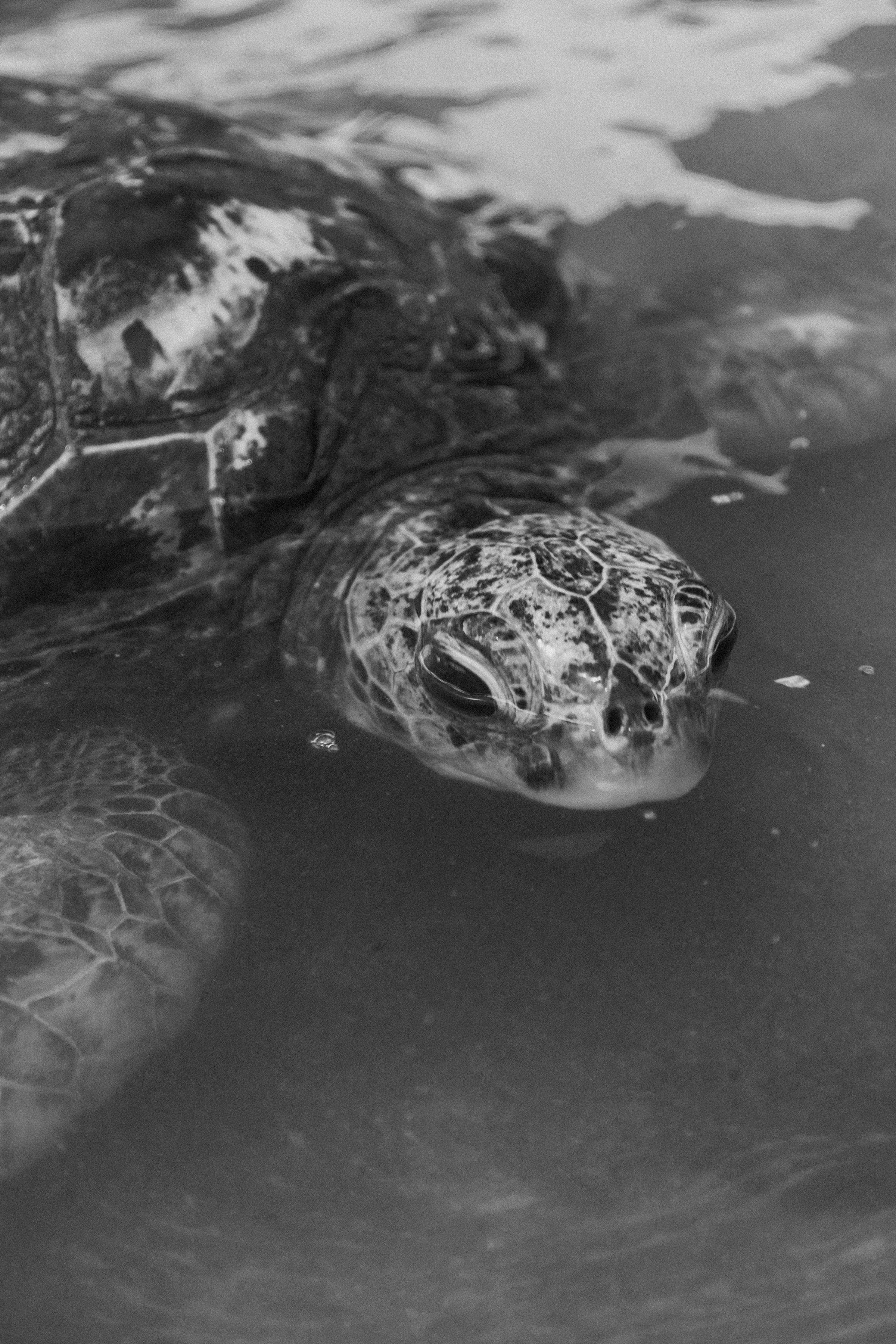
In Saint-Leu, on the west coast of Réunion, the turtles gliding through the shallow waters today tell a story few visitors would guess. Two decades ago, many of these animals were raised to be eaten. Now they are rescued, treated and, when possible, returned to the ocean. The transformation happened at one site, and it changed the way an entire island relates to its marine life.
The place began, in the 1970s, as something very different. A former lime kiln in Saint-Leu was converted into the Ferme CO.R.A.I.L, short for Compagnie Réunionnaise d’Aquaculture et d’Industrie Littorale. It was an intensive farm for green sea turtles taken from the waters of northern Réunion, raised under a ranching method and destined for consumption as meat, oil or scales. For more than fifteen years the operation continued, despite international legislation and an ecological campaign against the practice. “Very quickly, after the farm was created, there were controversies about the breeding conditions and the fact of eating sea turtles,” recalls Mayeul Dalleau, the director of Kélonia. In the 1990s the farm closed, and its future hung in the balance.
What saved the site was the knowledge that had accumulated there. Rather than let the expertise disappear, the Réunion region decided to buy the facility and transform it. The Ferme Corail gave way to Kélonia, a name drawn from the Latin chelona, meaning turtle. Chelonia mydas is also the scientific name of the green turtle, the species the old farm had raised and the most abundant in Réunion’s waters. In 2006, the centre became the island’s observatory for marine turtles, equipped with a care facility able to receive between 40 and 70 animals a year and a scientific team. Some staff from the Ferme Corail were kept on, though their jobs changed completely. Today about thirty employees work there, caring for turtles that arrive mainly after collisions with boats or accidental capture by line fishermen.
That last group of people has become part of the solution. In recent years Kélonia has built a partnership with Réunion’s fishermen, and it began at their initiative. “It was they who came to us of their own accord, because they were accidentally catching turtles,” explains Mayeul Dalleau. The fishermen now bring the animals back to the centre themselves so they can be treated. Care lasts from a few weeks to several months, and some turtles stay for life, too vulnerable after an accident or illness to survive back in the ocean. Plastic pollution adds another danger. “More than 80% of the turtles that arrive at the care centre have ingested plastic,” says Claire Jean, the centre’s scientific manager.
The results of this shift are visible from the air. In 1998, when counts began, aerial surveys over the west coast from Saint-Leu to Saint-Paul recorded just five turtles at the surface. Today observers count more than a hundred, a clear sign of growing abundance. Claire Jean is careful to share the credit. Other organisations, she notes, also do awareness work: the CEDTM, the marine reserve, Globice. “All our combined messages help change habits in the relationship Réunion’s people have with the environment, and by extension with the tourists who visit the island.”
Meanwhile, the centre has become a scientific reference far beyond the island. Its team developed the TORSOOI platform, a database gathering information on nesting, individual turtles and threats, built around photo-identification. “We developed a specific method to recognise turtles from birth to adulthood; at the moment it is the only recognised method for identifying a baby decades later,” Claire Jean says with a smile. The technique, entirely a Réunion creation, reads the patterns on a turtle’s head, which form a design like a fingerprint. It is now used in the oceans of the world. Over twenty years, Kélonia has also developed an artificial nesting beach and turtle counting techniques, and it welcomes hundreds of schoolchildren from the region as part of its outreach.
The story of this place, from turtle farm to sanctuary, is told in a report by Radio France, available at https://www.radiofrance.fr/franceculture/podcasts/le-reportage-de-la-redaction/a-la-reunion-le-pari-reussi-de-kelonia-pour-proteger-les-tortues-marines-4028516, first broadcast on Thursday 29 October 2026, as the Erevan Conference on biodiversity drew to a close in Armenia on Friday 30 October, where signatory states of the convention on biological diversity reviewed their commitments.
For the people of Réunion, the work is not finished. “For us, the challenge will be maintaining the growth of these populations, so that they keep coming to Réunion, so that they find habitats that remain favourable, and so that the threats do not increase,” Claire Jean concludes. The turtles of Saint-Leu, once a commodity, are now a shared responsibility, and the islanders who once farmed them have become their most devoted guardians.